
On August 6th 2025, two Swiss ministers returned from Washington without a deal. The outcome? Starting immediately, customers of Swiss businesses will face a 39% tariff on already premium-priced products when exporting to the United States. This puts Swiss exporters at a staggering 24% disadvantage compared to their EU competitors, who benefit from more favorable trade agreements. It’s yet another competitive hurdle the Swiss economy must now overcome.
In this article, I want to draw out a critical lesson that Swiss business leaders—and policymakers—should internalize: when you don’t have power, you must build better alternatives. The key to overcoming a power imbalance in negotiations is not simply to argue harder, threaten more convincingly, or hope for generosity. It’s to prepare, creatively question your assumptions, and—most importantly—strengthen your BATNA (Best Alternative to a Negotiated Agreement).
Let me take you into a real case study that illustrates this lesson beautifully.
The Power Imbalance: Innoagri vs. Solantar
In Shanghai, a company named Innoagri—a manufacturer of heavy agricultural and mining machinery—found itself in a bind. Their operations were outdated, and they urgently needed to upgrade. The only supplier of the specialized machinery they needed? A company named Solantar, which held a government-protected monopoly across China.
Solantar knew it. They proposed a sky-high price—not just for the equipment, but also for an attached service contract. Innoagri had no legal way to import comparable machinery, and so they were facing what many would call a take-it-or-leave-it deal.
Sound familiar?
When the U.S. decided to impose tariffs on Swiss products, Switzerland found itself in a similar corner. The U.S. is a vital export market, and the Swiss delegation had little leverage to stop the decision. Like Innoagri, Switzerland was negotiating under the weight of a sole-supplier dynamic, where one side sets the terms and the other is expected to comply.
But what happened next in the Innoagri story shows us that all is not lost—even when it feels like it is.
The Creative Turnaround
Instead of accepting the power imbalance, Innoagri’s team, with the help of a negotiation consultant, did something bold: they began preparing as if Solantar went out of business tomorrow.
What if the monopoly evaporated overnight? What would they do?
This radical reframing forced the team out of their despair and into creative problem-solving. They explored redesigning their processes to avoid the need for Solantar’s equipment altogether. They reached out to competitors to see if their equipment could be adapted. Nothing quite worked—until someone had a breakthrough idea:
Find another Solantar customer willing to sell used machinery.
In a matter of days, they found a company in Mongolia with exactly the equipment they needed—willing to sell it at a reasonable price. It wasn’t a perfect option, but it was viable. It was their new BATNA.
With this in their pocket, the dynamic at the negotiation table shifted. Innoagri was no longer a helpless buyer. They had an alternative—and they made sure Solantar knew it.
The result? A deal was struck. A fairer price. A service contract that made sense. And both sides walked away satisfied.
Switzerland’s Path Forward
Switzerland cannot rewrite what happened in Washington. The tariffs are here—for now. But we’re not powerless.
The lesson from Innoagri is this: build alternatives, and you build leverage.
For Switzerland, that may mean:
-
Strengthening ties with the European Union, politically and economically.
-
Building new partnerships with countries in Asia, Africa, and Latin America.
-
Investing in industries that are less vulnerable to protectionist measures, and diversifying the sectors we export from.
-
Exploring new market opportunities where Swiss quality is still seen as worth the premium—even with additional costs.
The EU recently signed a €750 billion liquefied gas deal with the U.S., buying time and favor in trade discussions. This wasn’t charity; it was leverage. Switzerland may not have the same economic scale—but it can still act strategically, not reactively.
Final Thought: It’s Okay to Come Back Empty-Handed—If You Come Back Smarter
For the two Swiss ministers, coming back without a deal is not failure. It’s a signal. A signal that power must be built, not assumed. And building power means investing in alliances, alternatives, and creativity before the next round of negotiations begins.
In negotiations—as in geopolitics—you can’t beg for leverage. You have to build it.
Let this be the moment Swiss businesses and policymakers ask themselves the hard question:
If Solantar disappears tomorrow, what’s our plan B?
The future may just depend on the answer.
Constantin-Alexandre Papadopoulos is a B2B sales and negotiation consultant. He serves clients across the DACH region and teaches negotiation & sales at FH Graubünden, the Swiss Armed Forces Command for Leadership & Communication, and advises blue-chip companies and SMEs across Switzerland.
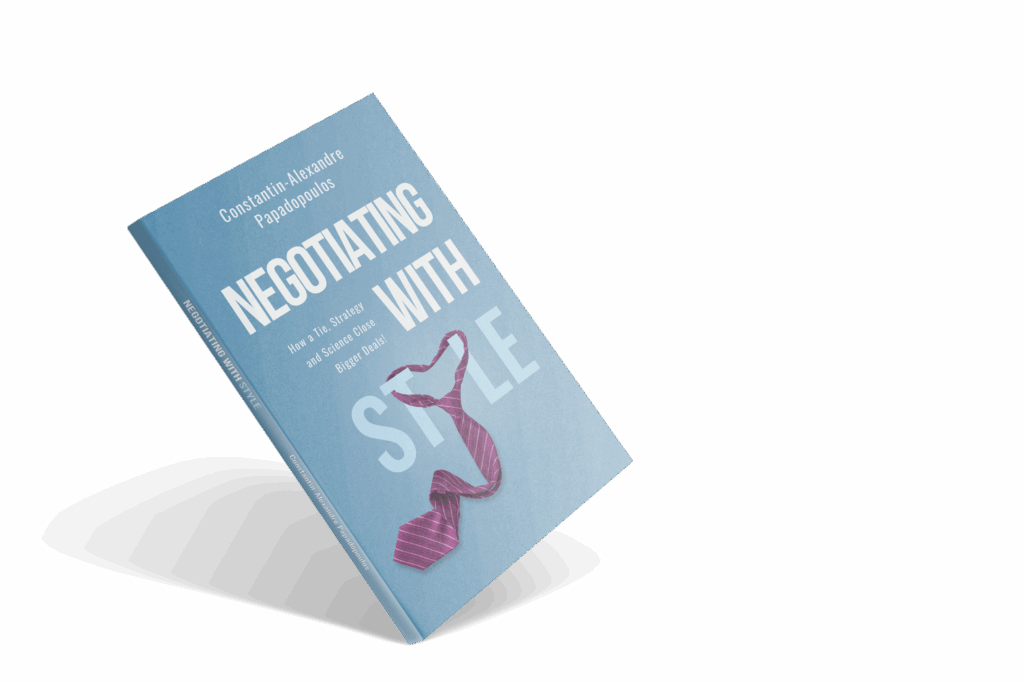
His first book – Negotiating With Style – is available as a E-book and paperback on Amazon.