Sometimes, negotiation is less about what is said and more about what is staged.
The meetings of mid-August offered two powerful visuals:
August 15 – Donald Trump meets Vladimir Putin in a three-hour tête-à-tête on a military base in Alaska.
August 18 – Trump welcomes the Western coalition — EU, NATO, UK, France, Italy, Germany — alongside Ukrainian president Volodymyr Selensky in Washington.
Without diving into the content of these conversations, the mise-en-scène alone speaks volumes about how power, influence, and positioning are negotiated.
1. The Location: Ground as a Signal

Presidents Trump & Putin meeting on a military base in Alaska, flanked by F22 fighters.

The Western politicians in Washington
For his meeting with Putin, Trump didn’t stay in Washington. He flew seven hours to Alaska — a former Russian territory.
While far from neutral, the setting projected a form of equidistance: closer to Russia than Washington, but still firmly on American soil. It was symbolically clever — a subtle message of shared history and geographic pragmatism.
By contrast, the EU leaders and Selensky came to Washington. That inversion matters.
When one side travels, they’re already playing on the other’s turf. In negotiation psychology, location sets the frame: the host defines the context.
2. The Participants: Top-to-Top vs. Boardroom Politics

We are having a casual conversation…

… whilst we’re trying to solve a world-crisis.
The contrast between the two meetings is striking:
Trump & Putin → An intimate, three-hour one-on-one. No advisors. No committees. Two men, two chairs, one narrative: equals.
Trump & the EU coalition → A large business-style conference room. Trump at the head of the table, the EU leaders seated like division heads reporting to a CEO.
This visual hierarchy matters. In one picture, Trump positions himself as Putin’s peer. In the other, Trump positions himself above the EU leaders.
The EU’s structural challenge is on display: seven voices, seven agendas, one table. It dilutes their leverage before the negotiation even begins.
3. The Decorum: Clothes as Strategy

Could President Trump look more condescending in this picture?
In high-stakes diplomacy, clothing isn’t accidental. It communicates intent.
Putin wore a formal suit and tie → the classic uniform of a statesman.
Trump mirrored this → signaling parity.
Selensky, however, wore his signature combat-style jacket, without a tie → projecting wartime leadership.
Around him, Selensky’s “big brothers and two sisters” — France, Germany, the UK, Italy, and NATO — were dressed as business leaders. The visual tension is striking: the fighter vs. the executives.
For an American president trained in corporate optics, Selensky’s attire reinforces an implicit frame:
Putin is a peer, Selensky is a petitioner.
4. Lessons from the Pictures
Trump and Putin see themselves as equals.
Their staging — two men, one room — projects balance.Trump doesn’t see Selensky as a world leader.
The visual cues suggest hierarchy, not partnership.The EU’s biggest weakness is fragmentation.
Seven negotiators, seven positions — and no unified voice.In geopolitics and business alike, one voice beats many.
Negotiating as a collective only works when intentions are canalised into a single message. Without that, power disperses.
The Missed Opportunity
I would not want to live anywhere else but Europe — for its values, freedoms, and diversity.
But as these images show, our leaders make it hard to be proud of Europe’s geopolitical posture.
A coalition of 27 nations cannot compete in high-stakes negotiations if it behaves like a fragmented committee.
In boardrooms, just as on the global stage, one chair must speak for all.
Constantin-Alexandre Papadopoulos is a B2B sales and negotiation consultant. He serves clients across the DACH region and teaches negotiation & sales at FH Graubünden, the Swiss Armed Forces Command for Leadership & Communication, and advises blue-chip companies and SMEs across Switzerland.
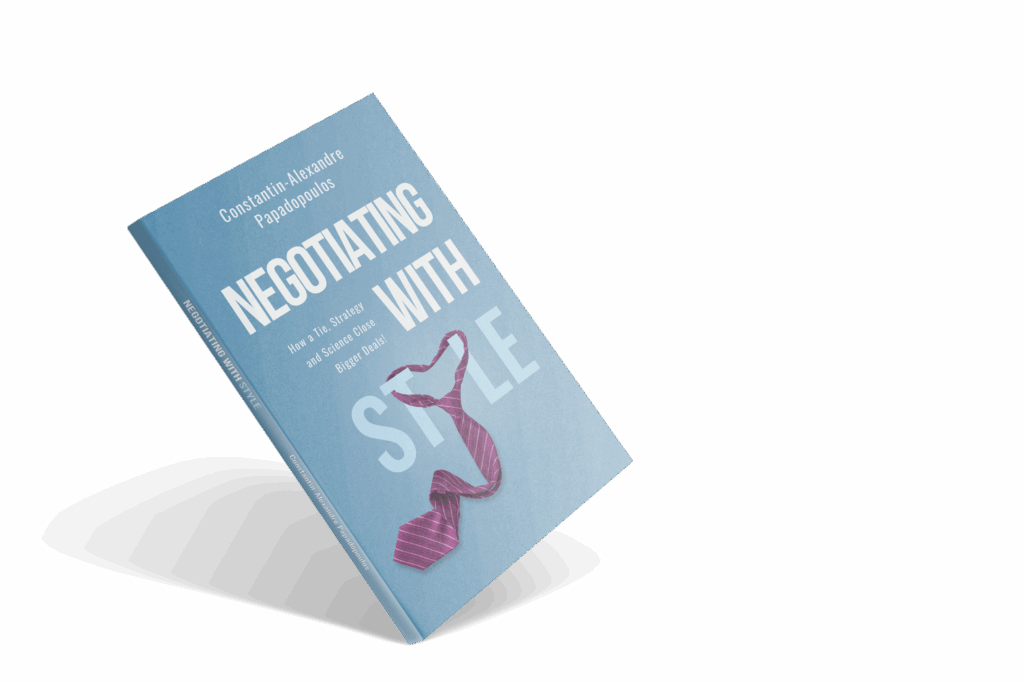
His first book – Negotiating With Style – is available as a E-book and paperback on Amazon.