
“But Constantin, my customers are smart. Rational. Analytical. There’s no way they’ll fall for your psychological tactics.”
I hear this all the time.
Sales professionals—especially those selling to strategic or technical buyers—tend to believe that success depends purely on the logic and quality of their offer.
ROI. System compatibility. Implementation timeline. That’s what matters, right?
They’re convinced that things like tone of voice, framing, or offer structure couldn’t possibly sway a buyer who “makes decisions with their head.”
So I ask them a simple question:
Do you think a judge—trained to be neutral and rational—can be influenced by cognitive bias?
The usual reply: “Hmm… I don’t know, but probably not.”
Wrong.
The Judge Who Skipped Lunch
Let’s look at one of the most famous studies in behavioral science.
In 2011, researchers Danziger, Levav, and Avnaim-Pesso analyzed over 1,000 parole decisions made by Israeli judges.
Here’s what they found:
-
Right after a meal break, parole was granted in 65% of cases.
-
Right before a break, that number dropped to almost zero.
Same judges. Same laws. Same cases.
The only difference? Glucose level.
🧩 Other studies confirm that even judges—yes, the gold standard of impartial decision-making—are affected by:
-
Anchoring – First numbers bias the decision
-
Framing effects – Presentation shifts perception
-
Confirmation bias – We seek info that proves us right
So if judges aren’t immune…
Why would your buyer be?
What does this mean for you?
It means that persuasion matters—not as a trick, but as a skill.
A strategic, ethical, and everyday tool that helps you guide the conversation.
And where do you start?
With Robert Cialdini’s Six Principles of Influence—the fundamentals of persuasive interaction, proven across industries, cultures, and decades.
The Six Principles of Influence (Sales Edition)
1. Liking – We say yes to people we like.
🧠 We like those who are similar to us, who show genuine interest, and who treat us as more than a transaction.
Try this:
“You used to work at Swisscom? My brother was in procurement there.”
Not small talk. Buy-in.
2. Authority – We follow credible experts.
🚨 Don’t lead with your product. Lead with your track record.
Try this:
“We’ve helped 18 firms in your sector reduce downtime by 25%.”
Don’t say trust me. Show why they should.
3. Social Proof – We follow the crowd.
Nobody wants to be the last to act.
Try this:
“Three of your peers in this cluster already use us.”
“Most CIOs I speak to are focusing on vendor consolidation right now.”
4. Reciprocity – When someone gives, we want to give back.
Give value first—even if it doesn’t immediately pay off.
Try this:
Send a tailored analysis or a smart benchmarking insight before your meeting.
Even a small gesture builds goodwill and momentum.
5. Consistency – We act in line with our past words.
Get small agreements early—and tie decisions back to them later.
Try this:
“At the beginning, you said alignment between Ops and IT was essential. This option does exactly that.”
6. Scarcity – We value what’s limited or exclusive.
Scarcity drives action. But it must be real.
Try this:
“We only onboard two new clients in your sector per quarter.”
“This pricing model will change after Q3.”
Ready to Level Up?
Once you’ve integrated these six into your daily habits, go further.
Try:
-
Anchoring – Set the first number and define the range
-
The Decoy Effect – Use an unattractive third option to steer the choice
-
Multiple Offers – Give choices that lead to the same outcome
These are not tricks. They are tools.
Final Thought
If you believe persuasion tactics are for the weak, you’re already giving away power.
The best negotiators don’t manipulate—they guide.
They don’t push—they frame.
And they don’t trick—they win early by preparing better.
So learn to use these tools. Practice them daily.
Start with Cialdini. Then layer in anchoring, decoys, and structured choice.
Because in great negotiation, the counterpart doesn’t even realize they’re in the net—
Until it’s already closed.
Constantin Papadopoulos is a negotiation expert, sales trainer, and founder of Snipers.sale, a consultancy helping B2B teams turn conversations into commitments. He has trained hundreds of professionals across industries to close complex deals with clarity, structure, and style.
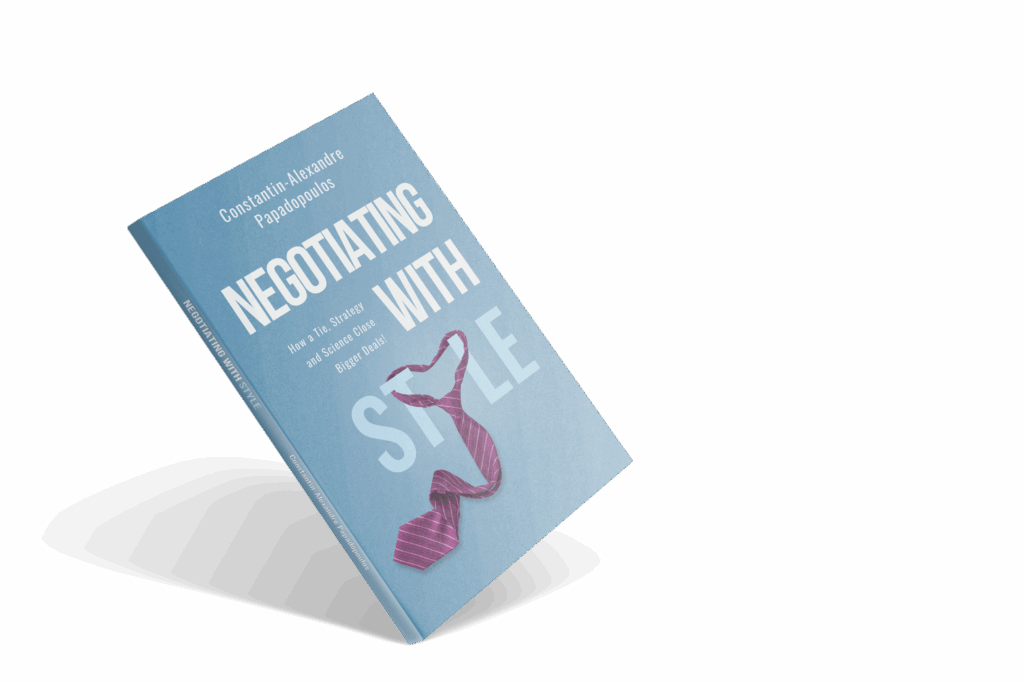
He is the author of Negotiating with Style: How a Tie, Science, and Strategy Close Bigger Deals — a book that blends personal stories, research-backed techniques, and battle-tested sales strategies.
In it, he explores how confidence, preparation, and a few well-placed questions can outperform raw power or charm.
Follow him on LinkedIn or subscribe to the blog for weekly insights.